
Good Afternoon.
Some years ago, Kevin Carr suggested to me that my endless and often frustrated endeavours to improve our protection market might be more effective if they were channelled through a pressure group of those who shared my desire to improve what we collectively did for those consumers who trust us and buy from us.
We recruited Roy McLoughlin and Alan Lakey to the cause, called ourselves the Protection Distributors Group, and recruited several others, with my then LifeSearch colleague Emma Thomson taking the chair. We are now a fully incorporated and very well supported group of do-gooders, with Neil McCarthy following Adam Knowles as chair after Emma.
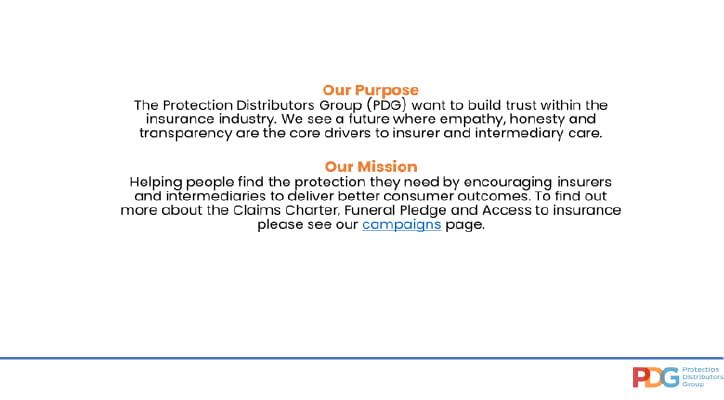
This is our purpose and mission. And after this talk, do have a look at our very clear website, created by Ian Sawyer.
Our first initiative in improving consumer outcomes was a Funeral Payment Pledge, where we signed up almost all insurers to agreeing to pay out a cash sum, pending probate. Generally up to £10,000. This resolved a genuine frustration and cause of dissatisfaction amongst claiming customers, by enabling funerals to be affordable in a timely fashion through the insurer taking on the tiny risk that they might face pressure to pay the sum out again if probate demanded it. Until we came at them, that tiny risk was a blocker for many, though not all. We got all to move to the position of the best.
We are able to lead change for the better because we are not a self-interested trade body. We are altruists, albeit altruists that understand that the better our market serves consumers the better our businesses will be able to grow.
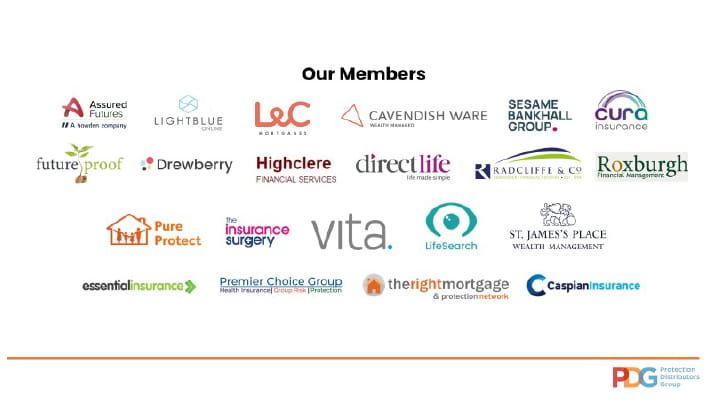
The other thing that helps us influence, is our growing membership. I’m told we speak for 70% of all protection policies sold with advice in the UK.
From generalists like SJP and SBG to specialists like LifeSearch or Drewberry to one woman or man bands, we are a growing force for good. Any adviser can apply for membership.
We vet applicants to ensure their track record demonstrates that they share our altruistic intent and if they secure approval from existing board members and can pay the reasonable annual fee then they are in and can stand for one member one vote election to the 12-person board in due course.
After the Funeral Pledge, in 2018, we created our Claims Charter to outline what we feel should be standard best practice based on our collective experiences of helping our clients with their claims.
Beyond improving outcomes, we hoped the charter will get insurers to feel that their new business, from PDG members at least, is to a growing degree dependent on what they do for those customers who are claiming and can now only cost them profit.
For we understand that in protection, as someone once said…
The claim is our primary product, not the policy.
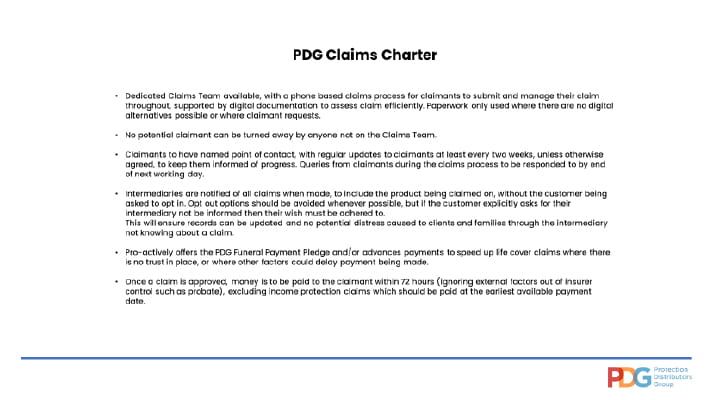
We decided that in order to help, not harass, insurers, we would not create subjective ratings – it’s simply a case of whether insurers confirm that their service meets the Claims Charter requirements. If so, we are pleased to award them our stamp of approval and promote this to the market.
You will see that we have kept it simple. There are many insurers who do much more than this in places, but the charter simply aims to secure a minimum level of support to claimants from all insurers.
We hope they will go above and beyond.
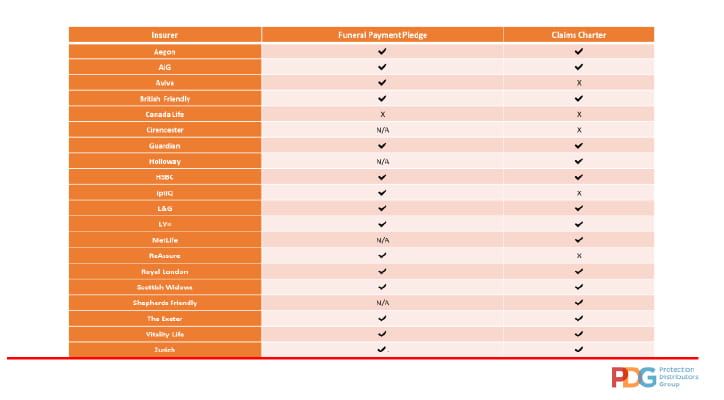
When we launched the charter, a few insurers met the criteria and were awarded the charter accreditation from outset, and the PDG worked hard to deliver change with the remaining insurers so that by 2021, nearly all providers met our minimum standards.
This year, mindful about how the pandemic affected service to claimants, and knowing there were certain firms not adhering to their charter obligations, we undertook a review of all the insurers to establish if they could maintain their accreditation. We identified some areas that had slipped and after explaining to those insurers that this would mean they lose their Claims Charter status, we were pleased to see those firms take rapid action to once again meet the requirements.
This review proved how important it is that we undertake this work annually to ensure standards are met. In recognition of the current claims experiences, the PDG has decided to also re-visit the charter’s requirements, so next year it may look a little different.
We created it with a set of only 6 minimum requirements, so though these have led to much insurer improvement, the Charter has limitations, one of which is that there is no requirement to assess the initial claim or subsequent evidence within a set period of time. We will therefore be looking at how we can extend the Charter so that we build on the positive changes already made to push for further improvements.
Now insurer’s systems can make change slow and expensive, and those that don’t have ticks, are in that position because they are waiting for spend to be authorised so they can get there. A few years in though and almost all have demonstrated to us that they comply with all these (pretty basic) requirements.
Royal London and Guardian are the latest to earn the tick by overcoming their last fail versus our standards: Royal London got it by investing in improving their service levels so they can deliver comms and calls in line with the charter. And Guardian tightened their SLAs with a 3rd party so as to sort out their issue with paying out swiftly after a claim is agreed.
But Canada Life and Aviva will remain a Claims Charter no, because their systems won’t currently allow them to notify the intermediary every time there is a claim. We see that as a vital safeguard of a good claims outcome. Canada Life have it in their development plan to do that, Aviva tell us that won’t happen in the foreseeable due to the myriad of legacy systems they have to work with, albeit for any policy set up using their current system, they are able to inform advisers.
The remainder who don’t meet Charter standards are niche players who have specific issues, but assure us they are trying to get there.
Individual insurers tell us that the charter has improved what they do, and that we have focussed them on maintaining high standards, often exceeding those we set.
But…..it’s one thing to earn a tick by confirming that you comply. What’s much more important is that you actually do it right, every time. And that’s proving a lot harder.
Let’s hear about that reality from someone who helps clients with claims all day every day – someone on the PDG membership’s claims experience front line. An intermediary claims support manager. I’ll let Lisa Kelly tell you more. Lisa.
- - - - - - - - - -
Hello, my name is Lisa Kelly and I work at LifeSearch in the Customer Care Team.
My role is to support our claimants through their claims journey by ensuring they have regular updates, a friendly ear and, someone to liaise with insurers on their behalf so that they can focus on their recovery, or grief.
I am passionate about giving our clients the very best service with honesty, care and integrity. Having been through the claims process for my husband, I am well positioned to empathise with our claimants and provide a shoulder to lean on. I truly believe that if intermediaries and insurers build good relationships, together we can offer a claims service that is welcoming, reassuring and, pain free.
I provide our claimants with support and efficiency in a situation that they never imagined being in. When I first speak to them they are usually in shock and of course will probably not remember the majority of our conversation, so the first thing that I do is allow them to talk to me, they will advise me usually in conversation without any prompts from me to what has happened, how and when without me needing to ask too many sensitive questions, such as date and cause of death or diagnosis. I will then offer my condolences or sympathy if I haven’t done so already and explain how I can support them throughout the claim, I do this by explaining the claims process, that the first course of action is to call the insurer and complete their tele-claims with all the relevant information to hand, i.e. their current GP and specialist contact information and Death Certificate details.
This is the most efficient route so that the insurer can complete their first step process and ask any specific questions, and so send out the relevant paperwork, declarations and payment instructions by email or post to the client fast.
Or if they prefer, (and the insurer allows this, and all should) I can do this on their behalf. I will then send them an acknowledgement email or letter which contains the insurers contact details and the policy information.
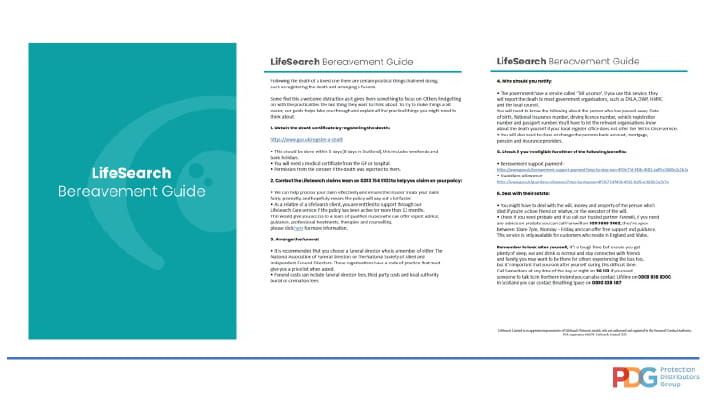
Also included with this email will be any relevant letter of authorities and, on a death claim. our LifeSearch bereavement guide. I explain this as a checklist that tries to make it clearer rather than insult their intelligence. A useful prompt or point of reference if you will.
I explain that once they have made the initial call, I will keep them informed of the progress of the claim throughout by gathering regular updates from the insurer so that they don’t have to.
I also ask for their assistance – we all know that the longest delay is getting the requested medical information from the doctor/medical professional to the insurer; so I ask our client to make their doctor aware that the insurer will be contacting them for medical information and that a fast response would make all the difference to them, the patient. Doctors tend to respond more efficiently to their patients request as opposed to an insurers request.
At this stage I will also signpost any ancillary benefits that are offered by the insurers as well as our own LifeSearch Care offering. I bring empathy into the process, but the real benefit I offer is experience, practicality and efficiency. Once I have sent the acknowledgement email, I will do the admin tasks – log the claim, open up a diary, and set the first reminder so that we are consistent in the updates that we are providing and that they are at the correct strategic points.
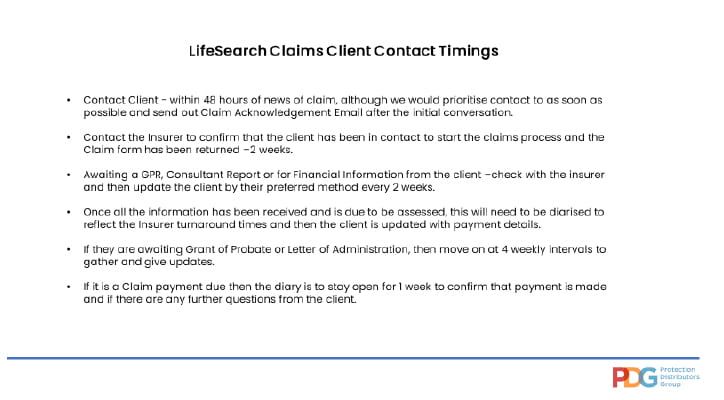
You can read our timetables for following up on the slide, but suffice it to say I work very closely with the insurers and just due to the amount of times that I speak to the same operatives I get to know them quite well, with some of them it’s almost like we work on the same team. There is even one insurer that the first thing that they do when I call them is put out a Teams message to say that they need to be left alone as they are on the phone to LifeSearch – I still haven’t decided if this is a compliment or not!
I have to stress that the relationship goes both ways, it is not unusual for insurers to contact me for my assistance especially when it is apparent that I have formed a relationship with the customer by providing PERSONAL CARE and that they have they have put their trust in me, it always amazes me when our client answers the phone ‘hello Lisa’.
***Tom interrupts***
‘Lisa, if I can just interrupt, that phrase you used their – personal care – that’s what insurers struggle culturally to deliver, but it’s exactly what good advisers are programmed to do from their first day at work. Insurers should want to work with good advisers so that individual clients can be got through their processes and systems with care and tolerance, honesty and efficiency. Their problem may be that adviser standards vary hugely, but that should not stop best practice! Sorry Lisa, carry on!’
***Back to Lisa***
I make sure they understand that I am not chasing or hassling them but wanting to assist/support them and that there is no rush – it is a very personal/individual thing. I have had an example that a wife called us literally 30 minutes after she had been told that her husband had committed suicide and this was just because she needed to be doing something proactive, needless to say she did not remember any of our conversation as she was totally in shock.
If dec’s or other responses have gone missing I will then gather the specific information from the insurer on how and when they were sent especially at the moment when we have mail strikes, if it was emailed it could also have gone into their spam folder – this is just so that the client is not left wondering why no one has been in contact at such a difficult time. I have had one insurer last week that had taken 30 working days to send out a claim form and in the end they had to send it to me to forward on to her – I had kept in contact with the bereaved wife and updated her each time I checked and escalated with the insurer, last Thursday we talked through the claim form and it was sent back by registered post on Friday.
The client may also be struggling with the actual filling in of the claim form, I have a recent claim where the lady is dyslexic and found the whole thing so daunting she had popped it to one side and ignored it. When we chatted and went through the requirements and we broke it down she was shocked at how straight forward it actually was.
While it’s good that insurers TAT’s are heading back to pre-pandemic levels, I find that during the claims process our clients mostly are very negative towards insurers and have this misconception that the claim will not pay out. Obviously I do everything I can to change this using my experience to offer reassurances without pre-empting a decision. I do this by making them aware at every point of the claim what the insurers action is driven by and actually means, that it is normal practice, or if not, why the different insurers have different criteria.
If our clients claim is declined, I explain the appeal process and act as a support without committing myself. I had a case where Mr had a Heart attack and died whilst driving with his wife and son in the car, he had set up 4 separate policies, LIFE, MPA, CIC and FIB with 4 different insurers on 1 UWME application, 3 paid and 1 declined. Based on my knowledge of all of the insurers and their information needs, and my ability to liaise with his widow, we finally got the decision reversed.
On the flip side, there are occasions where I support a fully declined decision and help the claimant or their family understand why the insurer is not in a position to pay the claim, either in full or in part. Through the relationship I build with claimants, it often helps to have me explain the difficult news and for them to accept the decision.
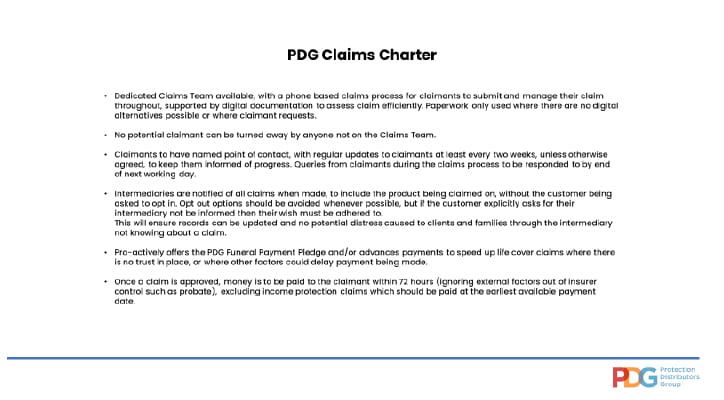
As Intermediaries/Brokers we are in a unique position to compare all the customer feedback and our own experiences when we have looked after a claim against the points that are laid out in the claims charter.
The Claims Charter’s points are set out on the slide behind me and I’ll go through each point from the view point of my own day to day experiences coupled with examples along with general feedback from our customers.
Almost all insurers comply with the first point, and paper forms as routine are thankfully long gone. This has helped make this process far more efficient. Pleasingly, almost all Insurers offer a tele-claim service where the claimant can speak to the claims team directly to start the process without any miscommunications and delays due to toing and froing from a middle person in one of their other teams.
With the exception of a couple of providers most also accept either a copy of the death certificate or even just the number and it is the minority that still insist on an original paper death certificate. The PDG should push for that to become universal I think.
There is very much work still to be done., We’re finding that even once the claimant has completed their tele-claim – we could be waiting between 5 and 35 days for the documents to be sent out if needed or on a simple case to be picked up for assessment. That can be up to 6 weeks from the client submitting their claim to the provider, to the provider notifying the claimant what they need to assess the claim…… for example a consultants report and/or GPR.
Those same insurers are picking up and assessing a new business application within 48 hours and issuing either terms or, a request for a GPR. Why isn’t the same excellent service given to those clients that are going through one of the toughest moments in their lives? Unfortunately, we’ve had claimants say to us that they feel the insurer was very quick and helpful in setting up the policy and taking their money but they haven’t felt that same care when they really need to use the policy they’ve been paying for.
I’m pleased to say the 2nd point no longer happens in my experience. In recent years nobody has complained that that they’ve encountered a gatekeeper who has turned them away from making a claim before they even reach the Claims Team.
As to the 3rd point, unfortunately for many insurers, fortnightly updates to the claimant just haven’t been happening, though since they have all recommitted to the Charter we are seeing improvement. But, generally communications through the lifetime of a claim, have been limited and lacking.
We know that assessors are busy assessing and delays are a day to day occurrence for them, however for the client this is them and they are unaware of these delays, and so perhaps empathy should feature more highly, to stop clients feeling that speed is not of the essence. Some of the insurers have automated updates by text which have also been described as insensitive.
A large number of claimants come to the intermediary directly to discuss their claim because it’s us that they have built the relationship with and us, that they feel comfortable with. This means that often, it’s the intermediary that is contacting the provider asking for updates on the status of the claim………a chosen spokesperson for the claimant if you will.
But we, as the claimant’s chosen spokesperson, find that emails we send asking for updates go unanswered for between 7 and 10 days. For this reason, we always try to call the provider in the first instance to get an answer quicker for the claimant.
Frustratingly, we find that some providers almost see us as a nuisance rather than viewing us as an extension of the claimant themselves. Whilst for the most part we manage to get answers faster by calling, we are faced with long hold times trying to access the claims team. We receive the same feedback from claimants who have tried to contact the insurer directly.
It’s unfortunate that some press articles around claims are about those claims that don’t pay out – and so customers really worry that that will happen to them. That worry only escalates when the claimant isn’t being kept regularly informed as to what’s going on with their claim. In the back of their mind, no news is not good news and instead, makes them feel that the insurer is working in the background to try and find a reason as to why they won’t pay out.
At a time when claimants are battling their health and or worrying about the very real, financial impact the death or disability is having on them and their family, the last thing they need to be is anxious about whether they can even afford to be ill. Regular updates are so important for a client’s physical and mental health. Even if there IS no news because say, you’re still waiting for the consultant to return a report – customers would rather hear this than complete radio silence.
As to the fourth point We’ve worked hard with insurers to encourage them to notify us of all claims and as a result, with the exception of a couple, they do, telling us which product is being claimed on without the customer having to opt-in.
One reason we are grateful for these notifications is because it allows us to ensure that we’re not unknowingly making inappropriate sales or servicing contact with the client or their family at a stressful and upsetting time. It also means we can check to see if there are any other policies or added value services the client could be claiming on. For example they may have made a claim on their IP plan, but not realised they could have also claimed on their Critical Illness policy which might be with another insurer.
Intermediaries who want to help can save insurers a great deal of time and reputation too. One of the benefits of claimants speaking to their intermediary in the first instance, is that we can check that the policy the claimant holds is active and hasn’t expired, and that the client has a suitable policy for the claim they are trying to make. We’ve had examples in the past of clients calling us to make a claim for a heart attack or cancer that they are recovering from when they hold a Life cover only plan.
This basic triage enables us to inform the claimant whether they are able to submit a claim or not and therefore helps insurers by reducing unnecessary inbound traffic allowing claims teams to work on valid claims.
And in the case of the 5th point I’m afraid we don’t know whether this is being proactively offered by insurers, though we raise it ourselves.
And the 6th, well we have one recent example where a claimant was treated very poorly when it came to payment, in fact, due to an internal system migration, it took 7 weeks from the time the claim was approved to it being paid and even then, that was with a great deal of intervention from us. That being said, this is certainly not typical of the experiences we see day in and day out. In fact, it’s quite the opposite and claimants are normally surprised and delighted at how quickly payment is made after their claim has been approved.
Overall, the Claims Charter is alive and well and this is great to see. Where I think improvement is really needed, is in that so important interaction between the insurer and the claimants. It falls back to empathy.
I’d love to see this element of the claims charter truly being adhered to now that insurers have recommitted to the charter and in some cases improved their standards, as this was certainly one area that had slipped.
I genuinely believe that Insurers want to do right by claimants and are looking for ways to improve the claims journey. I have had many conversations with different Claims department managers with this in mind, I’d love the PDG to consider some additions to the charter.
- So that it holds providers to account on timeframes for initial claim assessment upon receipt of the claim forms: 2-3 working days.
- Timeframes for medical evidence to be requested following assessment of the claim form - 2 working days and
- Timeframes for medical evidence to be assessed upon receipt from the specialist/GP – 5 working days.
A frustrating and hard thing to explain to a client is when one element of medical information is received and assessed but another element is still outstanding, when this does arrive, both elements then go back to the beginning of the work ‘q’ and the TAT’s start all over again.
We all want the same thing, and that’s for the policy we sell to our customer, to deliver its promise quickly and efficiently, and with human care and compassion when that moment of truth arrives.
Thank you Lisa.
Now before I wrap up I wanted to share a case history from a network, The Right Mortgage, passed on by their Vincent O’Connor. It’s not a tale of a wrongly unpaid claim of the sort Panorama might like, it’s an everyday tale of why poor insurer culture damages people and our reputation.
Vincent writes: In early April of this year one of our clients was diagnosed with cancer and started undergoing radio and chemotherapy. He claimed on the life or earlier CI policy we had set up. We had also set up a couple of life only policies.
Communications from the insurer (who was an early and enthusiastic charter signatory and is represented here today), were slow and curt and way outside the charter timescales.
The update the client did receive said the following on 25th May 2022...
Dear Mr Smith
To enable us to give full consideration of the claim we are awaiting a response from Professor Jones. I have contacted Professor Jones’ secretary to ask for a timescale for response if possible.
We will keep the response under review and let you know when it’s been received and assessed.
In the meantime, please let me know if you have any questions.
Kind regards
Now an insurer might say there isn’t a lot wrong with that letter. But the family have just had their world turned upside down and they don’t know whether this policy is ever going to pay out. This is pretty brutal language in those circumstances. Why not be gentle to those in distress?
Then, in this claim, silence persisted until the adviser chased on
5th July 2022 by writing thus:
Dear Claims Team,
Your last update was 25th May.
This claim started at the beginning of April, which now makes it three months. I urge you to consider the following happening within your own family:
Knowing that you have protected your partner and three children in the event of critical illness or premature death, and being unable to work due to radio- and then chemotherapy, along with other complications, you call and correspond with your very large life insurer, with whom you have entered into a contract and maintained the monthly premiums as required.
Communication is minimal and harshly worded. Due to the fact you are hospitalised, you are reliant on your partner, who has to work full time, look after your three children, visit you, and to chase the said insurer.
Please advise how you would feel?
That’s typical intermediary, all about the personal experience and emotion. Just like we, you, all should be.
I hope you agree that’s a fair challenge given the gap of around 6 weeks with no real progress.
As surprisingly often happens when we ping individual consciences, a short while later the claim was agreed and paid after the claims team got the evidence they needed to validate the claim from another source.
There were other errors. Ironically, the claim paid note said that they had paid out under terminal illness benefit, when it was the CI benefit. That triggered a surge of hope in the client and adviser that the much larger life policies would pay out. And consequent disappointment. For now.
We hope the life policies won’t have to pay out for TIB or Death, but the whole messy, slow, error strewn mini-saga is a good example of where a proud claims paid percentage masks a lot of very poor behaviours, underinvestment in service
and frankly cruel communications.
I think Vincent has that right.
We at the PDG are yet to decide our next steps to improve how our market treats claimants, but I know I’ll be asking that we try more actively and publicly to get insurers to make their good intentions a reality with more care and consistency.
They have a way to go, but I thought I’d leave you with this encouraging news.
Insurers have done well I think to get back to very similar levels in claims payment average times to those they were achieving pre-pandemic. If you all listen to Lisa and Vincent we can go on to improve on these, and be caring and courteous about it at the same time.
Go for it!